
Saved by a poet: The story of London St Pancras station
Discover how poet Sir John Betjeman helped save one of London’s most iconic buildings – St Pancras train station – and how it got a second life as the home of Eurostar trains across the Channel.
* This site contains affiliate links, where I get a small commission from purchases at no extra cost to you.
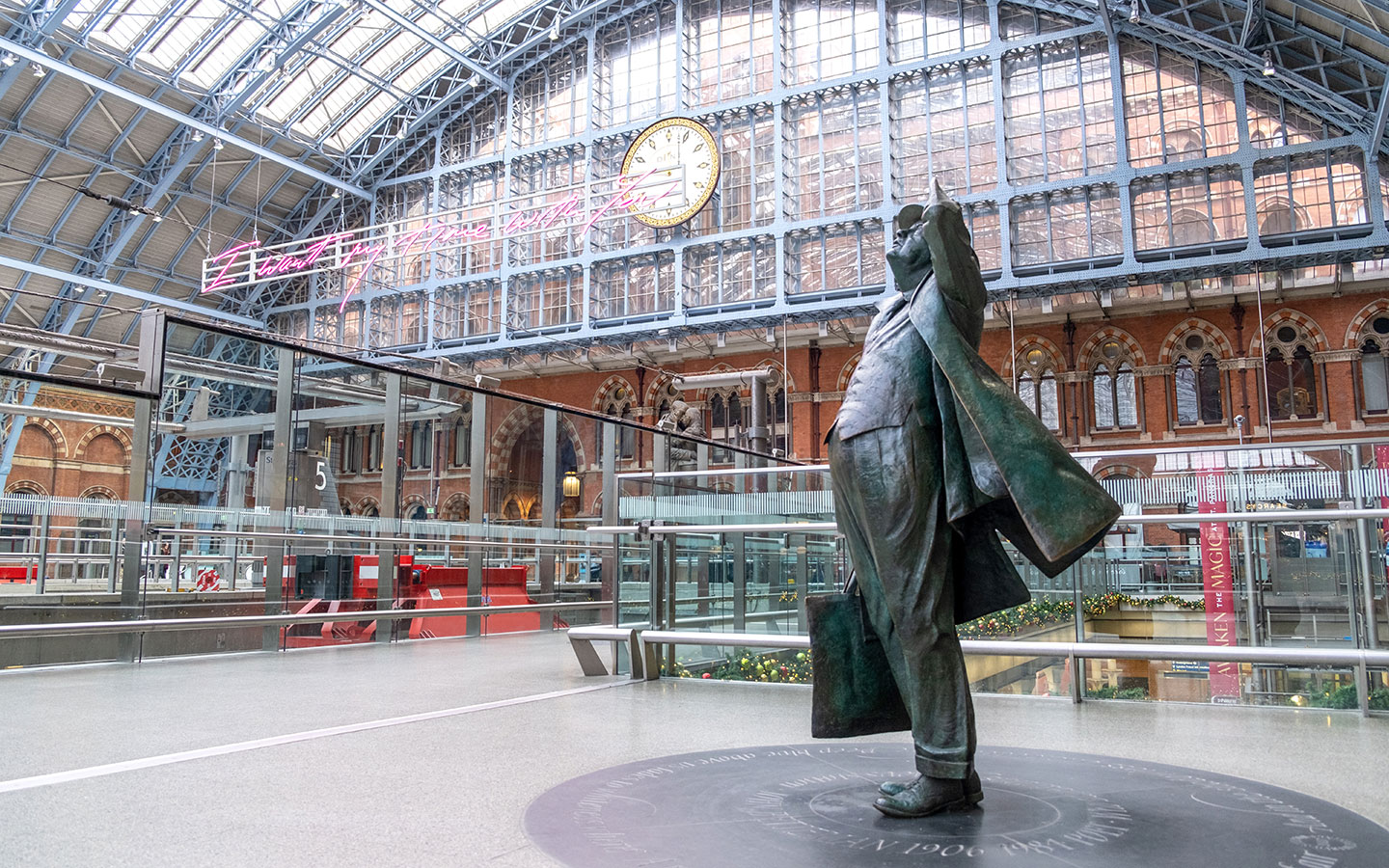
One of the benefits of taking the train to Europe rather than flying is that you get to pass through one of my favourite London buildings – St Pancras station. As you walk through the red-brick archways and under the huge, arched glass roof of this ornate Victorian Gothic building, it’s hard to believe it was almost knocked down 60 years ago.
Now it’s home to international Eurostar services as well as trains to the north of England. It’s been beautifully restored and is well worth a visit, whether you’re catching a train or not. But why was it nearly destroyed, and how did a poet help to save it?

The origins of St Pancras
St Pancras was built in the 1860s by the Midland Railway. At the time they had a network of routes in the Midlands, Lancashire and Yorkshire, but they had no lines into London so had to use other networks’ routes, which got busier and slower as rail traffic increased.
St Pancras was a less-than-salubrious area, but the railway company went all out to impress by commissioning a grand station and hotel. The train shed, designed by William Henry Barlow, was build on 850 cast-iron pillars topped with a 207-metre-long, 70-metre-wide arched glass ceiling – making it the largest enclosed space in the world at the time.
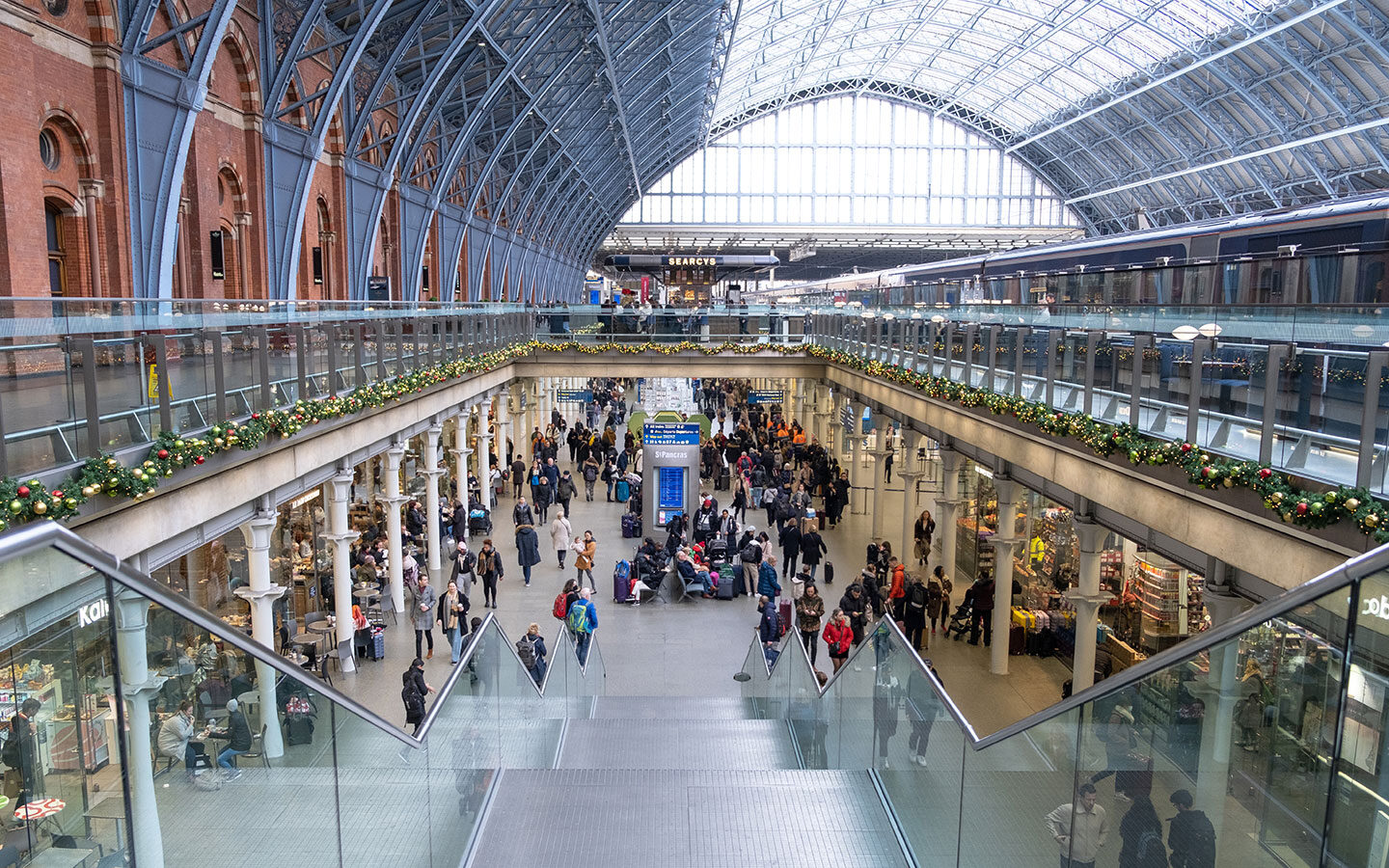
The station was raised up on pillars because the line had to travel over a bridge above the Regent’s Canal. And the area underneath was used for storage – the distance between the columns was calculated to fit in the maximum number of barrels of beer.
At the front was the Midland Hotel, designed by the architect George Gilbert Scott. He won a competition to design the hotel with his ornate Gothic red-brick structure, impressing the railway company into blowing their budget on it. And it took over 10 years to complete.

The station’s decline
Things started to go wrong for St Pancras in the 20th century. In 1925, the Midland Railway merged into the London, Midland and Scottish Railway, who used Euston as their main terminus. In 1935, the Midland Hotel closed down – profits had fallen, partly due to a lack of en-suite bedrooms, so it was used as accommodation for railway staff.
St Pancras was also damaged by bombing during the Second World War. And finally, changes to rail routes meant it wasn’t being used by enough train services to keep it running. This formerly grand building was seen as past its best. Its impractical design made it hard to covert and it was covered with years of London soot and grime.

By the 1960s there were plans to tear it down and redevelop the land into something more modern. But Poet Laureate John Betjeman, who was a great lover of Victorian architecture and co-founded The Victorian Society, set up a campaign to save it from demolition.
The Society had failed to save the nearby Euston Arch from being destroyed, and Betjeman said it would be ‘a criminal folly’ to see St Pancras go the same way. And he was successful – in 1967 the building was awarded Grade I listed status which meant it was protected. It was just in time too, as wrecking balls were due to move in just 10 days later.
Although the station was now safe from demolition, that still left the question of what to do with it. For the next 30 years it fell into decline. The former hotel buildings were abandoned, the rail lines hardly used and the roof was in danger of collapse.
St Pancras’ revival
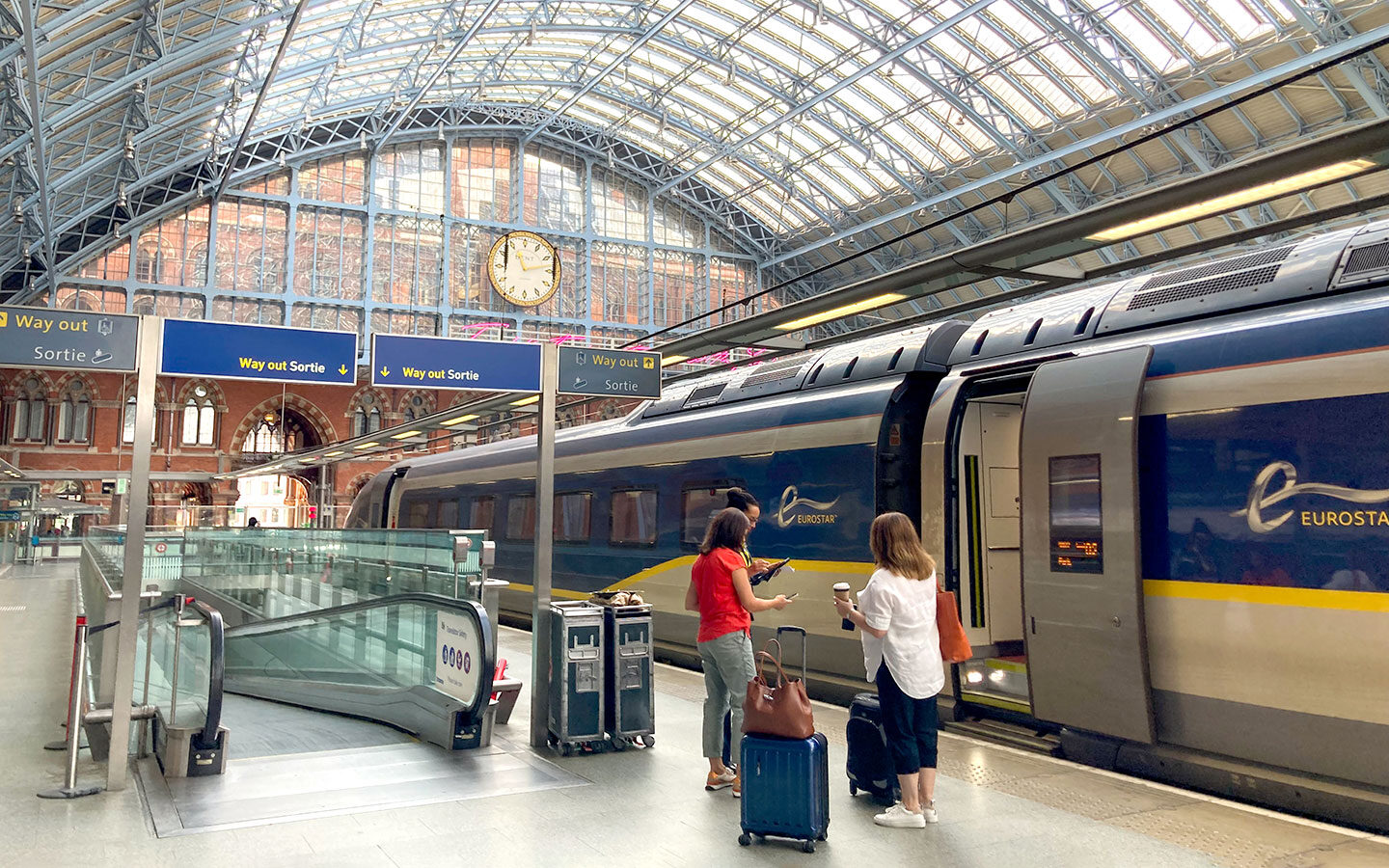
Although there were limited trains services in and out of St Pancras in the 1980s and 90s, its fortunes changed when it was chosen as the new terminus for international Eurostar services. A high-speed line was being built to connect the Channel Tunnel with London, and as it approached the city from the east, St Pancras was in an ideal position.
It took almost 13 years and around £800 million to renovate the station, but by the time it finally opened in November 2007 it was almost unrecognisable.
Layers of grime has been cleaned off the building to reveal the red-brick detail underneath. Barlow’s train shed roof had been repaired to its original design after wartime damage, with 18,000 panes of self-cleaning glass. The wrought ironwork was cleaned and repainted in Victorian light blue. And brass fittings were remade from original drawings.

The 18-foot-diameter station clock was replaced too. The original was due to be sold to an American collector in the 1970s, but it was dropped and broke while being moved. A train guard who was about to retire bought the broken version and painstakingly repaired it. And this was used as a template to make a new clock when the station reopened.
As the Eurostar trains are so long, an extra train shed had to be built onto the back of the original. The former goods area below the concourse was opened up, with shops and ticket offices tucked into the arches to leave the main space light and open. It has a public piano which has been played by Elton John, Jools Holland and Rod Stewart.
The station also had custom artworks made, including a nine-metre-tall statue called The Meeting Place by artist Paul Day, which shows a couple embracing at the end of the platform. Above it neon pink lettering by Tracey Emin says I want my time with you. And John Betjeman is honoured for his part in saving the station with a bronze statue.

St Pancras hotel
The final part of the station’s restoration was to renovate the old Midland Hotel. When it reopened in 2011 it was as the appropriately named St Pancras Renaissance, but it’s now known as the St Pancras London, Autograph Collection* and is run by Marriott.
Things are a bit different to its days as the Midland Hotel, which had the latest in electric lifts and flushing toilets, but only five bathrooms shared between its 300 rooms! It’s been renovated to five-star standard, with a new bedroom wing added on one side.

Today there are 207 bedrooms and 38 opulent suites, including one named after John Betjeman. En-suite bathrooms come as standard these days, but a stay in one of their Chambers Suites will set you back somewhere between £550 and £3500 a night.
But you can have dinner or afternoon tea with live music in their restaurant, The Hansom. Or try a traditional Victorian punch in the Booking Office Bar 1869, the station’s original ticket office which has a 29-foot-long bar and high vaulted ceilings.

While you’re there, take a peek at the spectacular Grand Staircase, where you can just imagine ladies in 1920s silk gowns and men in dinner jackets making their grand entrance to dinner (or less glamorously the Spice Girls filmed their Wannabe video here).
The station is also home to the longest Champagne bar in Europe, stretching along the length of the Eurostar platform. And at the end John Betjeman’s statue looks up at Barlow’s original ceiling. So if you’re ever passing through St Pancras and stop off for a glass of bubbly, raise a toast to Betjeman as none of this would be here today without him.
St Pancras tours
If you’re interested in finding out more about the history of St Pancras station, guided tours are available. You can either pre-book a group tour for up to 10 people for £145 or there are ‘turn up and go’ open tours on occasional dates (normally every other month).

Save for later


You might also like


The refurb is beautiful; I did like St Pancras in the ’90s, but obviously it needed some TLC. I love that they re-instated the 18ft Dent clock; BR attempted to sell it c1978 to a wealthy American, but while dismantling it dropped & smashed on the floor & instead sold to Nottinghamshire Railwayman Roland Hoggard for £25, who lovingly pieced it together bit by bit to hang on his barn wall – Decades later Dent were able to faithfully re-create a new clock from the original, and reinstate it in it’s rightful place at St Pancras. Mr Hoggard attended the grand re-opening in 2007 🙂
I remember taking a train to Norfolk in 1964 from St Pancras. It was frightening and black and massive. It is so beautiful now. I am so glad it was saved and cherished.
I moved to London when I was 17 yrs old. Escaping a small village in Lincolnshire, I arrived at Kings Cross Station. Walking out of Kings Cross passing by St Pancreas, I remember being really curious about the building, it seemed to dwarf all that stood around it yet it wasn’t alive. I have just read a brief outline of its history and it brought back clear memories of that time. Of being young, super aware of my surroundings and loving London.
What a wonderful review of my favourite station. I love going there, even as a day out. Every time I go I see more and more. I have now taken to ‘Days out at St Pancras’, so much to see in and around the station. On a warm day sit outside and watch the world go by, take a camera with you, I do, it is Great Britain at its best, with the history and architecture and the modern world all rolled into one.
Such a wonderful building, I love travelling from there as it always makes the journey feel extra special.